Jaluino Bee v2.0
(but where is v1.0 ?…)
I’ve been working for several months by now on a new Jaluino board, Jaluino Bee. I’ve designed a first PCB (v1.0), tested it with more or less success and now have ordered (and received) a second batch of PCBs (v2.0). From all i could test it seems to work “out of the box”, so now is the time to expose this…
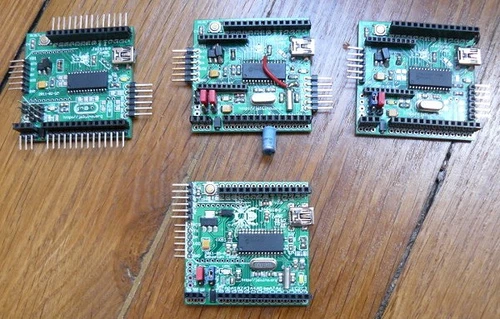
By the time I started to design Bee, I had the following constraint: provide a board as cheap as possible, with several options depending on user’s needs. This is one reason why I switched to SMD components and one main different characteristic from Jaluino Medium, for instance.
So Jaluino Bee is a small, 5cm x 5cm, board, using mostly SMD components. I had two microcontrollers in mind when I designed it: PIC18F27J53 and PIC18F25K22. Both are recent Microchip microcontrollers. 18F27J53 is USB capable, amongst many other very interesting features (RTCC for instance), while 18F25K22 isn’t USB capable but can run very fast (16MIPS). Both are supported by Bee though, I must admit, I’ve been playing much more with PIC18F27J53.
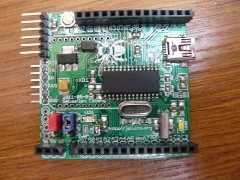
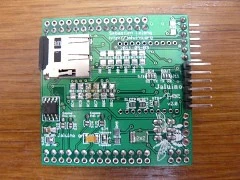 Jaluino Bee v2.0, bottom side
So here some more bullet point specifications. Some are common, others depend on select MCU (18F2550 is here just for the comparison with more modern PICs — and also in case you have one in your box –):
| PIC18F27J53 | PIC18F25K22 | PIC18F2550 | |
| RAM | Â 3.8K | ||
| Program memory | 128K | ||
| Max. speed | Â 48MHz (12 MIPS) | Â 64MHz (16 MIPS) | Â 48MHz (12MIPS) |
| USB | Â Yes | No | Yes |
| RTCC | Yes | No | No |
| Internal osc | Yes, and USB low speed | Yes | Yes (but no USB at all) |
| Power supply | Â 3V3 | up to 5V | up to 5V |
| Serial | Â 2 | 2 | 1 |
| I²C | 2 | 2 | 1 |
| SPI | 2 | 2 | 1 |
| Remappable pins | Â Yes | No | No |
| CCP | 7 | 2 | 1 |
| ADC channels | 13 (12 bits) | 19 (10 bits) | Â 13 (10 bits) |
| Price (Microchip, volume pricing) | $2.66 | $1.62 | $3.44 |
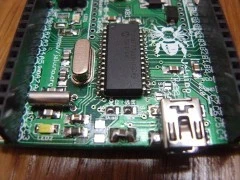
In addition to this list, we can add the following common features:
- Micro SD-Card slot (not compatible with PIC18F2550)
- 3V3 power supply (no more 3V3/5V conversion, most nice little chips/module are 3V3)
- Reset-via-RTSÂ feature
- On-board LED
- Powered by USB and external batteries (can skip voltage regulator to use 2×1.5V AAA batteries)
- Optional pullups placeholders on many pins if your application needs it (well, you can add them on all SPI lines for instance if case you’ve troubles with SD-Cards…)
- Resettable fuse (250mA, on the safe side)
- Xbee socket allowing to plug, well, Xbee modules, but RFBee, Bluetooth Bee modules. Xbee socket also comes with optional
- Amazingly sweet, nice, great looking board :)
Jaluino Bee can also have a optional, extra memory chip (not compatible with PIC18F2550). Depending on the needs, this chip can be (same pinout):
- 23K256 SRAM: to give an extra RAM amount for greedy applications
- SST25VF010A TransFlash: if you don’t need SD-Card but still want some flash memory
- 25LC080SN EEPROM: because PIC18F27J53 doesn’t have EEPROM… Just in case.
I’ve also designed a small shield, mini-Crumboard shield. It comes with a prototyping area (PTH components) as well as several SMD pads (SOIC, SSOP, SOT, etc…). Hopefully this shield can be used either as a prototyping one, or as a final application shield.
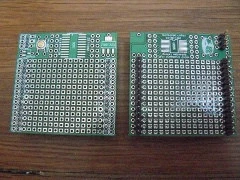
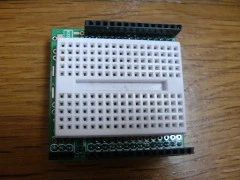
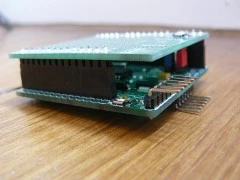
So what now ? Well, when I sourced SMD components, this was a real nightmare… And though you get cheap components, you often get hundreds of them. So I may be able to provide kits. Without extra memory chip, and Xbee module of course, I’d expect such a kit to cost ~$10…
To be continued !